
28 October 2026
Indoor air quality in UAE homes: how the experts measure it, and the machines that fix it.
Short answer: good indoor air in a UAE home means fine particles (PM2.5) under 12 µg/m³, CO₂ under about 800 ppm and relative humidity between 40% and 60%. You only know where your home stands by measuring for one to two weeks, which is how HawaQ, the group's indoor air quality experts, test homes. Then fix the cause you found: a HEPA air purifier such as MedicAir for dust and particles, a dehumidifier such as Stadler Form for humidity above 60%, a humidifier for air below 40%, and fresh air for high CO₂.
Most of life in the UAE happens indoors. The US Environmental Protection Agency estimates that people spend about 90% of their time inside, where some pollutants are often two to five times more concentrated than outdoors. In a Dubai villa or an Abu Dhabi apartment the doors and windows stay shut for much of the year and the air conditioning recirculates the same air, so whatever gets in, or is made inside, tends to stay. This guide explains what indoor air quality is, how professionals measure it, how to read the results, and which equipment fixes which problem.
What is indoor air quality?
Indoor air quality (IAQ) is the condition of the air inside a building, judged by the pollutants it carries and how comfortable it is to breathe and live in. Professionals describe it with a handful of readings: fine and coarse particles (PM2.5 and PM10), carbon dioxide (CO₂) as a measure of fresh air, volatile organic compounds (TVOC) and formaldehyde from furniture and cleaning products, relative humidity, and temperature. No single reading tells the whole story, which is why a proper test logs all of them together.
Why is indoor air quality a particular problem in the UAE?
Four things come together in UAE homes:
- Fine dust from outside. IQAir's country data put the UAE's 2025 average PM2.5 at 36.4 µg/m³, 7.3 times the World Health Organization's annual guideline of 5 µg/m³. Sandstorms and construction push fine dust indoors, where it settles and is stirred up again; HawaQ explains why the house gets so dusty after a sandstorm, and what Dubai's outdoor AQI means for the air in your rooms.
- Humid sea air. Coastal homes take in moist air all year. Air conditioning removes moisture only while the compressor runs, so rooms that cool quickly, closed wardrobes and storage rooms can stay damp. Above 60% relative humidity, mould and dust mites thrive.
- Sealed, recirculated air. Closed bedrooms with the AC on let CO₂ build up overnight, and chemicals from new furniture, paint and cleaning products have nowhere to go.
- What we burn and cook. Bakhoor, oud, candles and cooking add smoke particles and gases; see HawaQ's guide to bakhoor and indoor air quality.
Which readings matter, and what are good levels?
Dubai Municipality publishes both a guideline limit for each reading and an indoor air quality index (EIAQI) with a "good" band. Readings in the good band most of the time mean a healthy home; regular peaks above the limit point to a cause worth fixing.
| Reading | What it tells you | Good (Dubai EIAQI) | Dubai Municipality limit |
|---|---|---|---|
| PM2.5 | Fine particles from dust, traffic, cooking, candles and incense, small enough to reach deep into the lungs | 0–12 µg/m³ | 35 µg/m³ (24-hour average) |
| PM10 | Coarser dust brought in from outside and stirred up by people, cleaning and the AC | 0–50 µg/m³ | 150 µg/m³ (24-hour average) |
| CO₂ | Whether a room gets enough fresh air for the people in it; high levels feel stuffy and tiring | 400–600 ppm | 800 ppm (8-hour average) |
| TVOC | Gases from paint, new furniture, cleaning products, perfumes and air fresheners | 0–0.3 mg/m³ | 0.6 mg/m³ (8-hour average) |
| Relative humidity | Too high feeds mould and dust mites; too low dries eyes and skin | 40–60% (comfortable) | 20–60%, and below 60% at all times |
The WHO's 2021 guidelines are stricter on particles than Dubai's limit: 15 µg/m³ of PM2.5 as a 24-hour average and 5 µg/m³ as an annual average. For humidity, Dubai Municipality recommends staying below 60%, and below 50% where feasible to control dust mites; HawaQ's guide to the ideal indoor humidity in UAE homes compares every official range.
Who measures indoor air quality in the UAE? HawaQ, the indoor air quality experts
HawaQ – The Air Quality Experts is the indoor air quality company of PRO TECHnology Group, the Dubai group that also runs EVO. Its experts have tested, monitored and improved indoor air in homes and buildings across the UAE and the GCC since 2017. Its method fits in three words: measure first, solve second, prove it. HawaQ recommends equipment only where the data shows a need, and measures again afterwards to show the problem is fixed.
For homes, HawaQ offers:
- A two-week home check-up for villas and apartments with musty smells, humidity, dust, allergies, a new baby, or new furniture and renovation. Monitors log nine parameters minute by minute for two weeks, an engineer inspects the AC (filters, airflow, condensate and visible contamination), and you receive a written report compared with WHO values and Dubai Municipality limits, with a short list of fixes.
- Mould testing and sick-home investigations for persistent odours, visible mould, or headaches and tiredness that ease when you leave home. These add a visual inspection, moisture readings and, where needed, laboratory samples, because sensors measure gases and particles but cannot identify mould.
- Year-round monitoring with permanent sensors, live dashboards and alerts, mostly for offices, schools, clinics and hotels.
Why two weeks and not one visit? Air at home changes with cooking, cleaning, guests, sleeping with the door shut and the AC cycling on and off. A single spot reading misses all of that; two weeks covers weekdays, weekends and patterns such as CO₂ climbing overnight in a closed bedroom. One point to know: a formal Dubai Municipality indoor air quality certificate needs testing by a laboratory accredited by the Emirates International Accreditation Centre (EIAC). HawaQ's monitoring shows how a home or building performs every day and helps find and fix problems before that test.
What devices and tools do the experts use?
A professional test is only as good as its sensors and where they are placed. HawaQ works with three monitor families:
- Kaiterra Sensedge, Sensedge Mini and Sensedge Go measure PM2.5, PM10, TVOC, CO₂, temperature and humidity; the Sensedge and Sensedge Mini also connect to building systems over BACnet, Modbus and an open API. PRO TECHnology is an authorised Kaiterra distributor in the UAE (the Sensedge range explained), and the Kaiterra Sensedge Mini is sold here on EVO. It reports to Kaiterra's cloud dashboard, which runs on a Kaiterra licence.
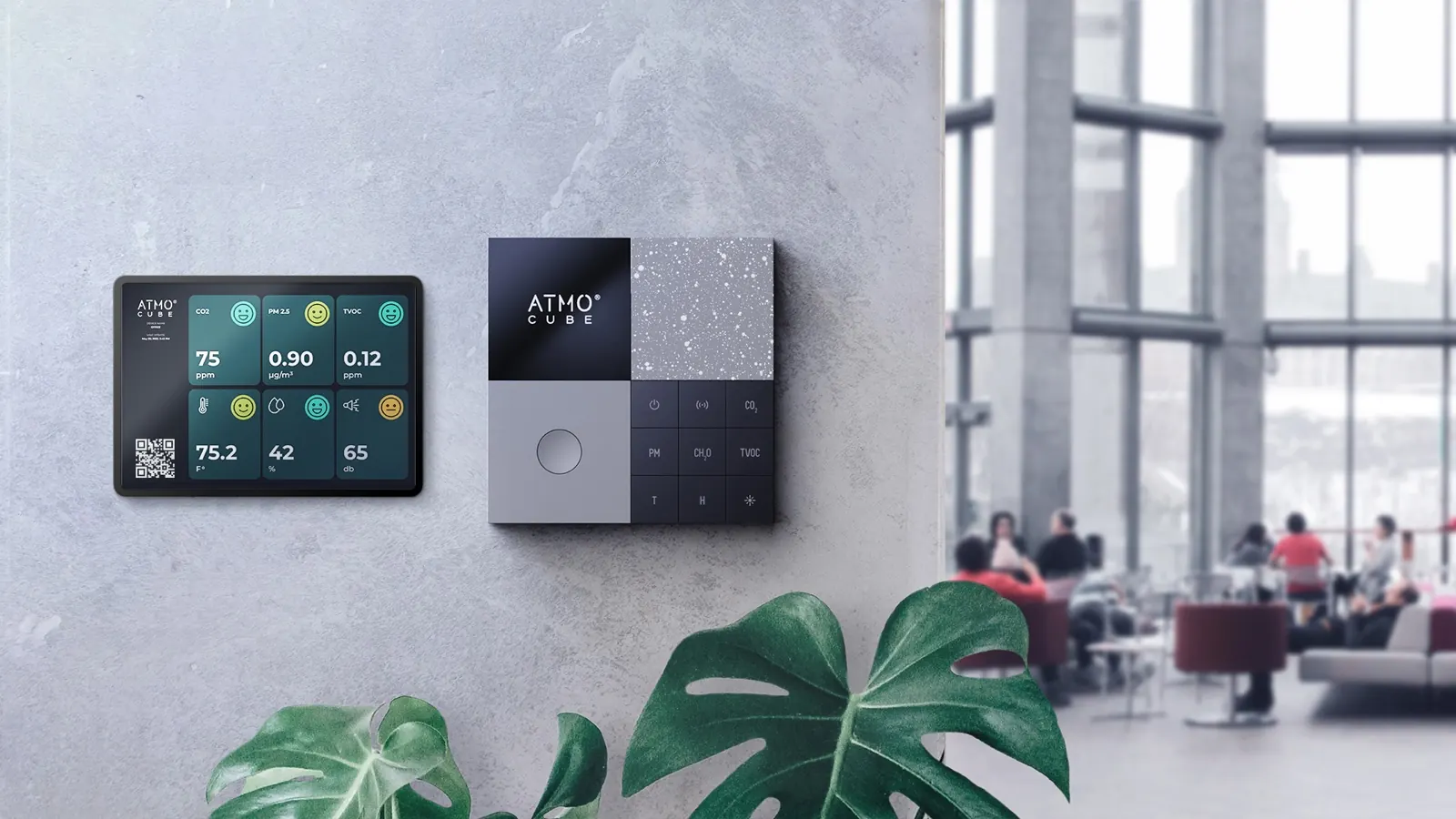
- Atmocube by Atmotech, a compact monitor for up to 11 parameters including PM1, PM2.5, PM10, CO₂, TVOC, formaldehyde, light and noise. HawaQ is its exclusive distributor in the GCC.
- Airthings monitors with a business dashboard, tracking radon, particles, CO₂, VOCs, humidity and temperature.
Placement matters as much as the model. Monitors go in the rooms people use most, at breathing height: Dubai Municipality's sampling method puts the sensor 100–200 cm above the floor, and the RESET Air standard asks for 0.9–1.8 m and at least 5 m from opening windows and fresh-air outlets. Keep them away from AC supply vents, kitchens and direct sun, which distort readings. Consumer monitors are useful for a first impression of CO₂, humidity and particles, but two cheap monitors in the same room can disagree; HawaQ explains why air quality monitors give different readings and how to test the air at home yourself.
How do you read the results?
Each kind of problem has its own fix. Buying the wrong machine is the most common and most expensive mistake, which is why the reading comes first.
| What the data shows | Likely cause | What fixes it |
|---|---|---|
| PM2.5 or PM10 often above the good band | Outdoor dust getting in, cooking, bakhoor, construction nearby | A HEPA air purifier sized for the room, doors closed; better AC filters |
| Humidity above 60% for hours, often at night | Sea air, an oversized AC that cycles off, closed rooms and wardrobes, drying laundry indoors | A dehumidifier sized to the space, set to stop at 50–55% |
| Humidity below 40% | Long AC hours in a dry inland home | A humidifier with a built-in humidity control |
| CO₂ above 800 ppm, mostly overnight | Not enough fresh air for the people in the room | Ventilation: fresh-air settings, a window or door gap; a purifier does not lower CO₂ |
| TVOC or formaldehyde high after new furniture or paint | Off-gassing materials | Ventilate, remove or air out the source; carbon filtration helps only partly |
| Musty smell, visible mould, mould in the AC | Persistent moisture | Fix leaks and humidity first, then clean; see black mould in the AC |
When the air needs purifying: MedicAir
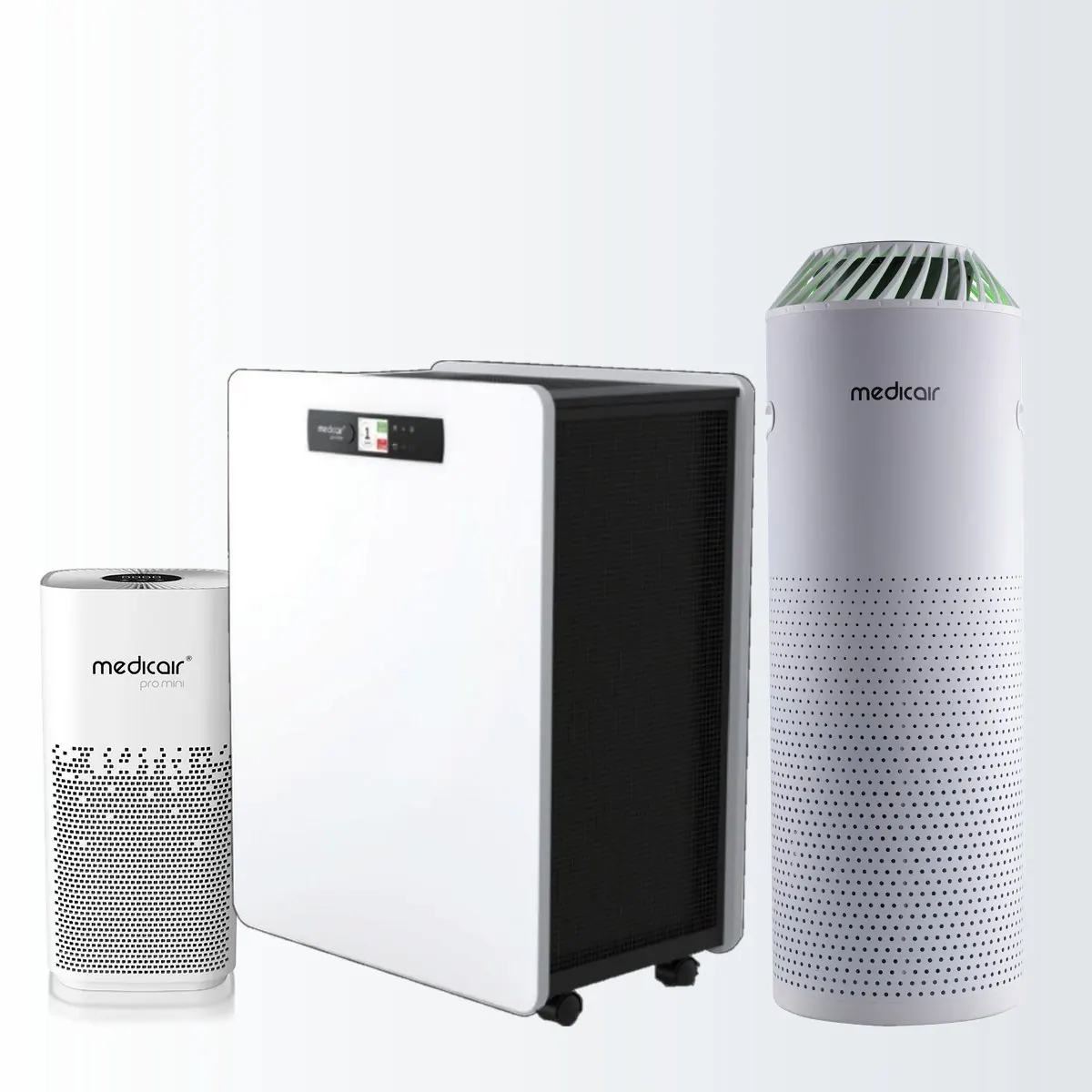
When the data shows particles, HawaQ's purification choice for homes is MedicAir, distributed exclusively in the GCC by PRO TECHnology Group and sold here on EVO. All three models share the same approach: a pre-filter, a HEPA filter, an activated-carbon layer for odours and an enclosed UV-C chamber. They differ in how much air they move, how loud they are and how easily they move between rooms.
| Model | Best for | Stated maximum airflow | Noise (manufacturer) | Weight |
|---|---|---|---|---|
| MedicAir Pro Mini | One closed room: bedroom, nursery, study | 400–410 m³/h | Up to 54–55 dB(A) | 5–5.6 kg, carried by hand |
| MedicAir Pro | Living room, majlis, family room | 605 m³/h | 28 dB at 180 m³/h, up to 60 dB at full speed | 14 kg, 88 cm tower |
| MedicAir Pro Max | Large open-plan living areas | 1,500 m³/h | 28–54 dB | 29 kg, on wheels |
How to size one: multiply the floor area by the ceiling height to get the room's volume, then multiply by the air changes per hour the room needs (MedicAir suggests about three for homes) and compare that with the purifier's airflow, leaving headroom so it does not have to run flat out. A 20 m² bedroom with a 3 m ceiling holds 60 m³ and needs about 180 m³/h, comfortably within one Pro Mini. An 80 m² living room with a 3.5 m ceiling holds 280 m³ and needs about 840 m³/h: one Pro Max, or two Pro units on opposite sides. HawaQ compares the three in detail in MedicAir Pro Mini vs Pro vs Pro Max, and PRO TECHnology publishes the full MedicAir specifications and a guide to purifiers for villas and apartments. A purifier will not fix humidity, mould on surfaces or stale air; those need the steps below.
When the problem is humidity: Stadler Form
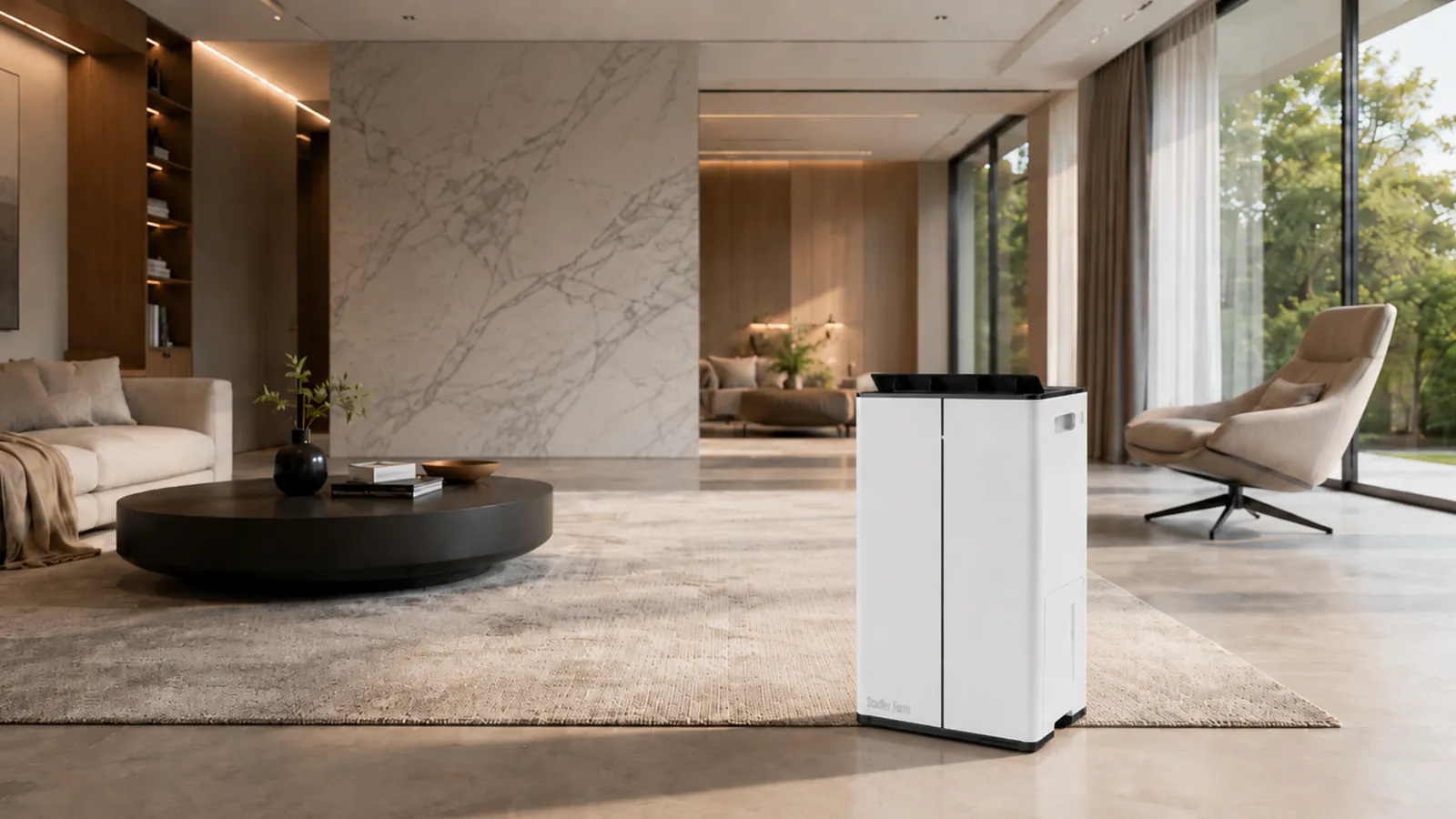
For humidity, the brand HawaQ specifies and EVO recommends is Stadler Form. Stadler Form is a Swiss design company founded by Martin Stadler in Zug in 1998, and its products have won 48 international design awards, among them a Red Dot Award for the Albert dehumidifier (2013), IDA Design Awards Gold for the Lukas dehumidifier (2024) and a Red Dot "Best of the Best" for the Karl humidifiers (2023). The range also holds seven function certificates for performance. In the UAE, Stadler Form is distributed and serviced by PRO TECHnology, which has helped more than 5,000 UAE homes bring humidity under control with Stadler Form dehumidifiers, backed by its own service centre and engineers in Dubai.
The strongest evidence is measured. HawaQ monitored more than 50 waterfront homes on Palm Jumeirah, Dubai Marina, JBR and La Mer for a month each, mapped humidity room by room, and fixed it with Stadler Form Lukas Pro dehumidifiers sized to each space (read the waterfront homes case study).
| Dehumidifier | Removes up to | Room size up to | Noise | Why choose it |
|---|---|---|---|---|
| Stadler Form Albert | 20 litres a day | 70 m² | 33–44 dB(A), with night mode | The quietest dehumidifier Stadler Form sells in the UAE at its lowest setting, made for bedrooms and nurseries; Red Dot Award winner |
| Stadler Form Lukas | 20 litres a day | 70 m² | 38–52 dB(A) | Wi-Fi control, laundry-drying mode, optional H11 particle filter; IDA Design Awards Gold |
| Stadler Form Lukas Pro | 50 litres a day | 175 m² | 38–55 dB(A) | 2-in-1 dehumidifier with an H11 particle filter for large rooms and villas; 5-year warranty; HawaQ's choice for waterfront homes |
| Stadler Form Theo | 10 litres a day | 40 m² | 42 dB(A) | A compact unit for a single smaller room |
The capacities are Stadler Form's rated maximums, reached from about 22 °C and 70% humidity, so a cooler air-conditioned room will see less water in the tank; size with headroom. Every model has a built-in hygrostat that switches the unit off at the humidity you set and on again when it rises, and each can drain continuously through a hose so it keeps working while you are away.
Why we rate Stadler Form as the best dehumidifier for UAE homes
We sell it, so weigh our view with that in mind. These are the reasons, each one you can check:
- Award-winning Swiss design. 48 design awards across the range, including Red Dot and IDA Gold for the Albert and Lukas dehumidifiers; the units look like furniture, not appliances (see the awards and what they do and do not prove).
- Quiet enough for a bedroom. The Albert runs at 33 dB(A) at its lowest setting, close to a whisper; see the quietest dehumidifiers for a UAE bedroom.
- Sized for UAE homes. From 10 to 50 litres a day and rooms from 40 to 175 m², with 2-in-1 filtration on the Lukas Pro.
- Proven in UAE homes. More than 5,000 homes helped by PRO TECHnology, and 50+ waterfront homes where HawaQ mapped humidity for a month before fitting Lukas Pro units.
- Supported locally. A UAE warranty of two years, five on the Lukas Pro, with repairs, spare parts and filters handled in Dubai; you can see and hear the units at the Stadler Form showroom in Business Bay.
To choose a model, read Stadler Form UAE's guide to the best dehumidifier in the UAE, its advice for villas, or answer a few questions about your room in the Find My Dehumidifier tool on bestdehumidifiers.ae, run by the HawaQ team. Stadler Form dehumidifiers are sold online at stadlerform.ae, the Stadler Form UAE store, with free delivery in the UAE.
When the air is too dry: Stadler Form humidifiers
Inland homes and long AC hours can push humidity below 40%, which some people feel as dry eyes, skin and throats. The Stadler Form Oliver is an ultrasonic humidifier for rooms up to 60 m² that runs at 28–38 dB(A) and passes the water past an integrated UV lamp before misting. The Karl (rooms up to 100 m²) and Karl Big (up to 150 m²) won a Red Dot "Best of the Best" in 2023 and can be controlled from a smartphone app. See all Stadler Form humidifiers. A humidifier belongs only where readings stay low; in most coastal homes the problem is the opposite.
When the problem is stale air: ventilation
High CO₂ means the room needs more fresh air, and no purifier, dehumidifier or humidifier changes that. In a bedroom, leaving the door slightly open, using the AC's fresh-air setting or running a bathroom extractor helps; in larger homes and buildings it is a ventilation design question. HawaQ's ventilation and filtration assessment checks how much outdoor air each space really gets.
A one-week plan for better air at home
- Measure. Put a monitor in the bedroom and the living room, or book a two-week home check-up with HawaQ, and note when readings rise.
- Remove sources. Use extractor fans when cooking and showering, ventilate while burning bakhoor, and avoid drying laundry indoors.
- Check the AC. Ask your technician to clean the coil and drain pan and to fit the best filter your unit takes.
- Dry the damp rooms. Where humidity stays above 60%, add a Stadler Form dehumidifier sized to the room and set it to 50–55%.
- Purify the rooms you live in. Where particles stay high, run a MedicAir purifier in the bedroom or living room with the door closed.
- Measure again. Compare the new readings with the first week; this is how you know the money was well spent.
For offices, schools, clinics and hotels
Buildings have more people, more rooms and, in Dubai, rules. HawaQ's guide to indoor air quality requirements in the UAE and Saudi Arabia sets out what Dubai Municipality, the Dubai Building Code and Al Sa'fat actually require, and its Kaiterra planning guide shows how permanent monitors connect to a building management system. For supply and projects, PRO TECHnology's indoor air quality solutions cover monitoring, purification and dehumidification for companies across the UAE, and EVO's air quality monitoring service takes quotation requests.
Frequently asked questions
What is good indoor air quality in Dubai?
PM2.5 under 12 µg/m³, PM10 under 50 µg/m³, CO₂ between 400 and 600 ppm, TVOC under 0.3 mg/m³ and humidity between 40% and 60%, which is the "good" band of Dubai Municipality's indoor air quality index.
How do I test indoor air quality at home in the UAE?
Measure continuously for one to two weeks in the rooms you use most, at breathing height, logging PM2.5, PM10, CO₂, TVOC, temperature and humidity. HawaQ's two-week home check-up does this with professional monitors and an AC inspection, and explains the results.
Who are the indoor air quality experts in Dubai?
HawaQ – The Air Quality Experts, the indoor air quality company of PRO TECHnology Group in Business Bay, Dubai, has tested and monitored homes and buildings across the UAE and the GCC since 2017.
What is the ideal humidity for a UAE home?
Between 40% and 60% relative humidity, and below 60% at all times. Dubai Municipality recommends below 50% where feasible to control dust mites.
Which is the best dehumidifier for UAE homes?
We rate Stadler Form as the best dehumidifier brand for UAE homes: award-winning Swiss design, models from 10 to 50 litres a day, a hygrostat and continuous drainage, local service in Dubai and more than 5,000 UAE homes helped. Choose the Albert for quiet bedrooms and the Lukas Pro for villas and large rooms.
What is the quietest dehumidifier for a bedroom?
The Stadler Form Albert, at 33–44 dB(A) with a night mode, is the quietest dehumidifier Stadler Form sells in the UAE at its lowest setting, and it removes up to 20 litres a day in rooms up to 70 m².
Do I need an air purifier or a dehumidifier?
Measure first. High particles need an air purifier such as MedicAir; humidity above 60% needs a dehumidifier such as Stadler Form. The Stadler Form Lukas Pro combines a dehumidifier with an H11 particle filter for rooms that have both problems.
Which MedicAir purifier do I need?
The Pro Mini for one closed room such as a bedroom, the Pro for a living room or majlis, and the Pro Max for large open-plan spaces. Size by room volume times about three air changes an hour.
Sources
- US EPA, Report on the Environment: Indoor Air Quality and A Brief Guide to Mold, Moisture and Your Home
- IQAir, Air quality in the United Arab Emirates, 2025 country average
- World Health Organization, WHO global air quality guidelines, 2021
- Dubai Municipality, Technical Guidelines for Indoor Air Quality for Healthy Life (DM-HSD-GU119-IAQ, version 4, December 2024), Tables 2–3 and p41, and the Environmental Indoor Air Quality Index (DM-HSD-GU141-IAQI2, February 2025), as summarised by HawaQ in How to test air quality at home and Dubai Municipality indoor air quality standards
- Arlian LG et al., Reducing relative humidity to control the house dust mite Dermatophagoides farinae, Journal of Allergy and Clinical Immunology, 1999
- RESET, RESET Air standard, monitor placement
- HawaQ, indoor air quality testing, monitoring and waterfront homes case study
- MedicAir figures as published by HawaQ and PRO TECHnology from the manufacturer's manuals, brochure and specification sheet; stated maximums, not independent room tests
- Stadler Form, awards and product data from stadlerform.ae and stadlerform.com
EVO, HawaQ, PRO TECHnology and Stadler Form UAE are part of the same group: PRO TECHnology distributes Stadler Form in the UAE and MedicAir in the GCC. This guide is general information, not medical advice.