
27 October 2026
Is an air purifier worth it in the UAE? Benefits, side effects and how to use one.
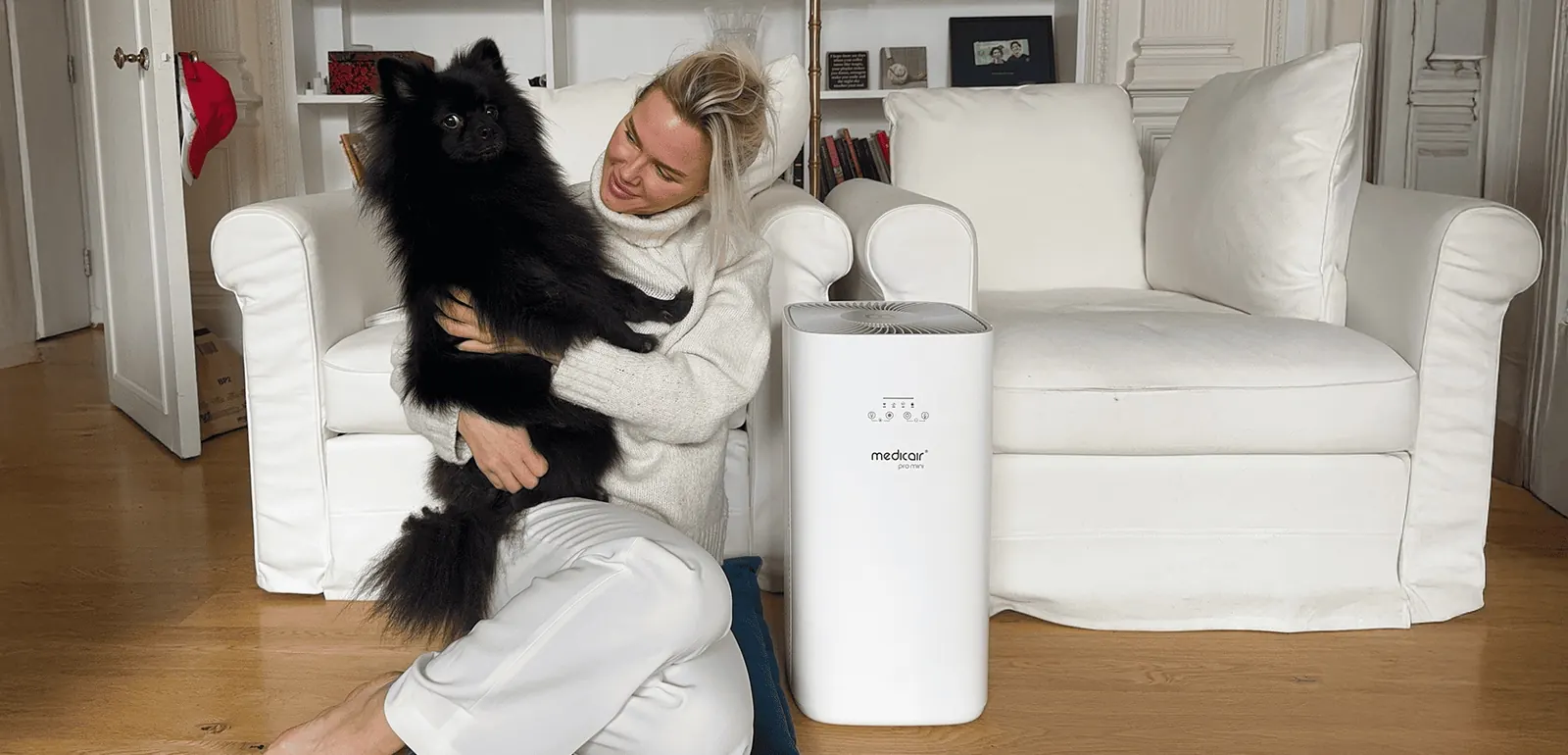
Short answer: for most UAE homes, yes, if the problem is particles. A HEPA air purifier that is sized for the room and left running removes much of the fine dust, pollen, pet dander and smoke that settle into air-conditioned rooms with the windows shut. It will not fix humidity or mould, it does not bring in fresh air, and it does not lower CO₂. Measure first, buy for the room you spend the most time in, and run it whenever the room is in use.
UAE homes are a special case. We spend most of the day indoors with the doors and windows closed and the AC recirculating the same air, while fine dust from the desert, cooking smoke, bakhoor and pets build up inside. The US Environmental Protection Agency estimates that people spend about 90% of their time indoors, where concentrations of some pollutants are often two to five times higher than outdoors. This guide explains what an air purifier really changes, where it does nothing, and how to set one up so it earns its place.
What does an air purifier actually do?
A portable air purifier pulls room air through a filter and pushes it back out cleaner. With a true HEPA filter (grades H13 and H14 under the European standard EN 1822) it catches very fine particles: dust, pollen, pet dander, mould spores and the particles in smoke. An activated-carbon layer adds some capacity for odours and certain gases. The EPA puts the limit plainly: no air cleaner or filter will eliminate all of the air pollutants in your home, and most filters are designed for either particles or gases, not both.
The measurable effect is on airborne particles. In a 2020 double-blind trial in Korea, adults with dust-mite allergy had two HEPA purifiers running in their living room and bedroom for six weeks; bedroom PM2.5 fell by up to 51.8% with the real purifiers compared with placebo machines.
Is an air purifier worth it in the UAE?
It is worth it when your problem is something in the air that a filter can catch. It is a weak buy when the problem is moisture, stale air or a source you can remove.
| Your problem | Will a HEPA purifier help? | What actually fixes it |
|---|---|---|
| Fine dust after a sandstorm or construction nearby | Yes, this is what it does best | A purifier sized for the room, doors closed; see why the house gets so dusty after a sandstorm |
| Pollen and pet dander | Yes, for what is in the air | A purifier in the bedroom, plus regular vacuuming of soft furnishings |
| Bakhoor, oud and cooking smoke | Partly: HEPA takes the smoke particles, carbon some of the smell | Ventilate while burning; read what bakhoor does to indoor air |
| Musty smell, damp, mould on walls or in the AC | No, it cannot dry the air | Lower humidity with a dehumidifier and clean the source; see mould in your AC |
| Stuffy room, headaches, high CO₂ | No, filters do not remove CO₂ | Fresh air: ventilation, or a fresh-air supply on the AC system |
| Strong chemical smell from new furniture or paint | A little, through the carbon layer | Ventilate hard for the first weeks and remove the source |
If you are not sure which of these you have, measure before you buy. How to test the air in your home explains what a consumer monitor can and cannot tell you, and an air quality monitor shows PM2.5, CO₂ and humidity side by side.
Do air purifiers help with allergies and asthma?
They help some people, modestly, and they work best alongside other steps. Dust is the most common trigger here: in a survey of allergic-rhinitis patients in the UAE, 59% said dust made their symptoms worse, 44% grass or pollen and 21% animals, and symptoms most often worsened in winter (37%) and spring (30%). Date-palm pollen, despite its reputation, rarely causes allergy: in a UAE University study only 2.3% of 477 allergic patients tested positive to it.
The research on symptoms is honest but unspectacular:
- A 2002 meta-analysis of ten randomised trials in homes of people with asthma found particle filtration improved total symptoms by about 5% to 8% and sleep disturbance by about 10%, with no overall change in medication use or lung function.
- A later review by Lawrence Berkeley National Laboratory concluded that particle filtration can be modestly effective, with improvements generally under 25%.
- A 2018 systematic review for the US asthma guidelines found air purifiers improved quality of life, but rated the evidence as low and found no effect on asthma control or lung function.
- In the 2020 dust-mite trial, people with the real purifiers needed less allergy medication, although their reported symptoms did not differ from the placebo group.
So treat a purifier as one part of allergy control, not a treatment. It does most for allergens that stay airborne (pollen, pet dander, smoke); dust-mite allergen is heavy and settles quickly, which is why washing bedding and vacuuming matter more for it. If you have asthma, talk to your doctor about your own triggers.
Are there side effects?
A HEPA purifier has very few. The risks come from extras, noise and neglect:
- Ozone. The EPA advises avoiding air cleaners that intentionally produce ozone, a lung irritant, and lists some ionizers, electrostatic, UV and plasma designs as able to emit it. California caps ozone from air cleaners at 0.050 ppm and certifies models that pass. Never use an "ozone generator" in an occupied room.
- UV-C and photocatalytic stages. MedicAir purifiers add an enclosed UV-C lamp in a titanium-dioxide chamber to their HEPA and carbon layers. The filtering is done by the HEPA and carbon; MedicAir does not publish an ozone or by-product test for the UV-C stage, so if that matters to you, ask for the data before you buy.
- Noise. A purifier only cleans the air it moves, and moving more air makes more noise. Check the noise figure at the speed you will really use, especially in a bedroom.
- Dirty filters. A clogged filter moves less air. MedicAir's filters are due at least every 12 months; see MedicAir filter prices and running costs.
- False reassurance. A purifier will not tell you about humidity or CO₂. Keep ventilating.
How big should my air purifier be?
Size it by clean air delivery rate (CADR), the volume of filtered air it delivers per hour, against the volume of your room. Health Canada's rule of thumb (a smoke CADR in cubic feet per minute of at least two-thirds of the floor area in square feet) works out to about five air changes an hour in a room with a standard ceiling. In metric:
Room length × width × ceiling height × 5 = the CADR you need in m³/h.
| Room | Volume | CADR for about 5 air changes an hour | MedicAir model that covers it |
|---|---|---|---|
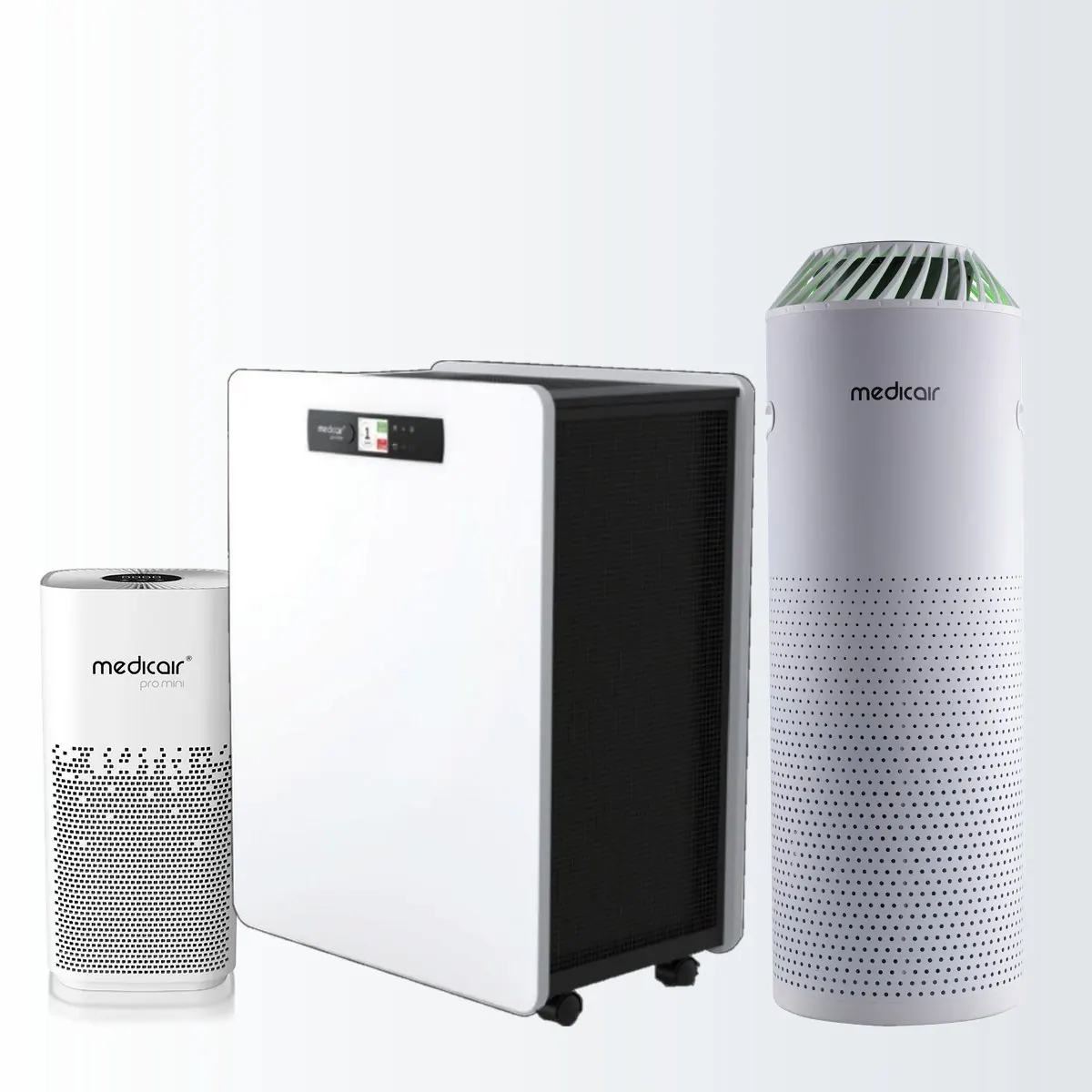
| Bedroom, 4 × 4 m, 2.7 m ceiling | 43 m³ | about 215 m³/h | MedicAir Pro Mini, up to 400 or 410 m³/h depending on revision |
| Living room or majlis, 35 m², 3 m ceiling | 105 m³ | about 525 m³/h | MedicAir Pro, up to 605 m³/h |
| Open-plan space, 90 m², 3.2 m ceiling | 288 m³ | about 1,440 m³/h | MedicAir Pro Max, up to 1,500 m³/h |
The capacities are MedicAir's own maximum figures; we know of no independent test of them. Capacity is measured at full speed, so a purifier running quietly at night delivers less. Choose one with headroom, and for a whole villa or apartment see how to size purifiers room by room.
Where should I put an air purifier?
- In the room you spend the most time in, as the EPA advises. For most people that is the bedroom: you spend a third of the day there with the door closed.
- Close to where you sit or sleep, with space around it. Keep the intake and outlet clear of walls, sofas and curtains; manufacturers typically ask for about 30 cm or more on each side. Do not hide it in a corner or behind furniture.
- Not blowing straight at people. Health Canada advises positioning it so it does not blow directly at or between people.
- With doors and windows closed while it runs, otherwise you are cleaning the corridor and the street.
- Away from the AC outlet's direct stream, so the purifier draws room air rather than the cold jet coming off the unit.
How long should I run it?
Whenever the room is in use, and leaving it on all the time is normal. The EPA's guidance is simple: higher fan speeds and longer run times filter more air. A practical routine:
- Run it on a higher speed for an hour before bed with the bedroom door closed, then drop to the sleep or lowest setting overnight.
- Turn it up during and after cooking, burning bakhoor, cleaning, or a dusty day, then step it down again.
- In living rooms, leave it on automatic if it has a particle sensor.
Running costs are low for a home unit: MedicAir lists the Pro Mini at 42 W, the Pro at 85 W and the Pro Max at 120 W at full power.
Do I need an air purifier if I have AC?
Usually, yes, if fine dust or allergies are the issue. AC cools and recirculates the air, but its filter is not built for fine particles. The washable mesh in most wall-mounted split units is there to protect the indoor coil from lint and coarse dust. Ducted systems in Dubai's newer buildings must carry at least MERV 8 filters under the Al Sa'fat green building rules; MERV 8 is rated mainly on particles of 3 to 10 microns, while a HEPA H13 filter captures at least 99.95% of the hardest-to-catch size, around 0.1 to 0.3 microns.
Two other things the AC will not do: most split units bring in no fresh air at all, and a neglected unit can spread mould spores of its own. If you want to know whether your system's filters are good enough, HawaQ's ventilation and filtration assessment checks exactly that. Run the purifier and the AC together; they do different jobs.
Do I need an air purifier in every room?
No. A portable purifier cleans the room it is in, and a closed door stops it reaching the next one. Start with the bedrooms of whoever has allergies or asthma, then the main living area. One large unit in the hall will not clean three closed bedrooms; either put a smaller unit in each room you use, or improve filtration on the central AC system.
How to choose a purifier that is worth the money
- True HEPA (H13 or H14), not "HEPA-type". Check which standard the grade refers to.
- A published capacity (CADR) that fits your room using the five-air-changes rule above.
- Activated carbon if odours, bakhoor or cooking smells matter to you.
- No intentional ozone. Avoid ionizers sold for their "fresh" smell and anything called activated oxygen.
- Noise at the speed you will use, not only at minimum.
- Filter price and life, which is the real running cost.
The MedicAir range covers all three room sizes with a pre-filter, a HEPA stage (H14 on the Pro Mini and Pro Max, H13 on the Pro, as specified by the manufacturer), activated carbon and an enclosed UV-C chamber. PRO TECHnology, MedicAir's exclusive distributor and partner for the GCC, publishes the full model comparison, including where the manufacturer's documents disagree. You can buy the MedicAir range on EVO, together with Pro Mini replacement filters, or compare every air purifier we sell. If you also want a humidifier, read using an air purifier and a humidifier together.
Measure before and after
The only way to know a purifier is working is to measure. A PM2.5 reading taken before you switch it on and again after a few hours with the door closed tells you more than any brochure. For a whole home, an office or a school, a professional indoor air quality test by HawaQ measures particles, gases, CO₂ and humidity together and points to the cause, not only the symptom.
Frequently asked questions
Is an air purifier worth it in Dubai?
Yes for fine dust, pollen, pet dander and smoke particles, which build up in closed, air-conditioned homes. No for humidity, mould or stuffiness, which need a dehumidifier, cleaning or fresh air instead.
Should I leave my air purifier on all the time?
Yes, whenever the room is in use. Longer run times and higher speeds filter more air; turn it up for cooking, bakhoor or dusty days and down at night.
Can I sleep with an air purifier on?
Yes. Run it on a higher speed before bed with the door closed, then switch to the sleep or lowest setting, placed close to the bed but not blowing at you.
Do I need an air purifier if I have AC?
Usually yes. AC filters protect the coil and catch coarse dust, while a HEPA purifier catches the fine particles the AC recirculates. Use both together.
Do I need an air purifier in every room?
No. Put one in each room you spend long hours in with the door closed, starting with the bedrooms; a single unit does not clean closed rooms next door.
Does an air purifier remove bakhoor smoke and smell?
Partly. The HEPA filter captures the smoke particles and activated carbon reduces some of the smell, but ventilating while you burn bakhoor does more.
Does an air purifier help with mould or humidity?
No. It can catch mould spores in the air, but it cannot lower humidity or remove mould growing on surfaces or inside the AC. Fix the moisture first.
Sources
- US EPA, Guide to Air Cleaners in the Home and Report on the Environment: Indoor Air Quality
- Health Canada, Using a portable air cleaner to improve indoor air
- California Air Resources Board, Air cleaner information for consumers
- Park KH et al., Effect of air purifiers on patients with allergic rhinitis, Yonsei Medical Journal, 2020
- Mahboub B et al., Prevalence and triggers of allergic rhinitis in the United Arab Emirates, World Allergy Organization Journal, 2014
- UAE University, Aerobiological studies and low allergenicity of date-palm pollen in the UAE
- Lawrence Berkeley National Laboratory, Indoor Air Quality Scientific Findings: allergies and asthma
- McDonald E et al., Effect of air filtration systems on asthma: a systematic review of randomized trials, Chest, 2002
- Leas BF et al., Effectiveness of indoor allergen reduction in asthma management: a systematic review, Journal of Allergy and Clinical Immunology, 2018
- MedicAir specifications as published by PRO TECHnology from the manufacturer's manuals and specification sheets
EVO, PRO TECHnology and HawaQ are part of the same group. This guide is general information, not medical advice.